Tuesday, April 19, 2016

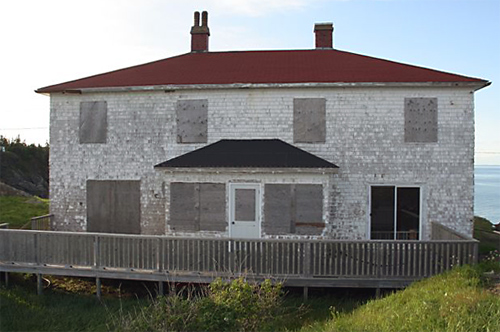
Southwest Head Lighthouse


Southwest-Head-Light-Grand-Manan_Simone-Ritter-Art_2016_watercolor_5x7in
Southwest Head Lighthouse- Grand Manan, NB
orig. watercolor, 5x7in approx.
see it in person at Sunbury Shores Arts Center May 6-20, 2016
This little painting is based on my visit at the Grand Manan Island. I have blogged about it before, you can read about it here.
The cliffs are super steep and the foghorn is mega loud- it almost took me off my feet when I stepped out off my car! The region is quite foggy by nature, so be aware and enjoy it for the moody scenery- of course on a clear day enjoy the view (and if you're lucky enough you apparently can spot two other lighthouses in the distance!)
There are beautiful beaches close by, so pack a picnic and enjoy the day.
My time for the Show at Sunbury Shores is coming fast,                                                                  so I'll be heading out to paint hopefully tomorrow early for a couple of days on Campobello Island. I have packed my 'Little Wings Campie' already, just have to finish a few last details (like an extra heater as we are still around freezing point at night) and load the art supplies (which actually might fill that little one to the brim, ha ha). I'm so excited as a local couple have invited me to boon dock with my trailer at their home. They run a successful Campobello Island Tour Company and are advocates in camping adventure travel. You can read more about Peter and his wife Beatrix on their busy blog by clicking here. I'm looking forward to meeting them in person as Peter and I had nice chats so far on facebook- it feels like meeting a friend for the first time- crazy, ey?
More lighthouses to come- and I'll keep you posted once I return!
Thanks for stopping by, and see you soon again!             Simone

Wednesday, April 6, 2016

Purple Tulips

Purple tulips Simone-Ritter-Art_2016_watercolour
Purple Tulips
orig. watercolour 14.5 x 7in approx. unframed 
more info and purchase: click here

People that know me, know that every spring I go crazy over tulips, it's kind of a love affair almost- heralding in the warmer weather. There is a tulip farm on Prince Edward Island called Vanco Farm and I absolutely adore their tulips. They are usually available at the local Superstores and every year I look out for them starting in February... how crazy is that?
With my lighthouses lately I haven't had the time to paint as much tulips as I wished, but when Markus bought for me those purple tulips darlings, I couldn't resist! I have been waiting patiently for them to open up, not pushing them with warm temperatures by the heater, but rather enjoying their gentle dance growing taller, opening up. 
I love how their slender stems keep climbing up towards the light, turning, stretching and nodding as the flower slowly opens up to reveal their precious petals, steamers and inside markings. It symbolizes new birth, new life to me. And just as life, it is not always easy but with the occasional growing pain and dangerously slippery road. In our lives, too, we have to walk out in faith our eyes focused, to embrace what every new day has to offer- whatever it might be. Life isn't for the faint of heart, really, when I think about it; but oh, so rewarding- look at those tulips!
Let's embrace this spring with a big hug, smile or gentle gesture to someone who might need it today! Just as those purple tulips have brought a smile to my heart!
See you soon and thanks for stopping by!                                              Simone

Monday, April 4, 2016

Swallowtail Lighthouse #2

Swallowtail #2 Lighthouse_Simone-Ritter-Art_watercolour-2016_21x29

Swallowtail Lighthouse #2

orig. watercolour 22x30in approx.
see it in person at Sunbury Shores Arts Center from May 6-20, 2016
This is another, big, full sheet 22x30in watercolour painting of my beloved Swallowtail Lighthouse on Grand Manan Island, I call it Swallowtail Lighthouse #2, here is my first painting of it from a few days ago. Have you booked your vacation there yet??? I am certainly thinking about it now after painting scenery from my last visit. My time seems to run for this upcoming show beginning of May and honestly, I'm getting somewhat in a frenzy of having all my ducks (aka: paintings) in a row. Too bad when one is loving to have events 'under control'- welcome to life, Simone, ha ha!
Markus, bless his heart, has been so great doing the schooling with the kids. It frees me to focus on the painting and organizing!
I took my Little Wings campie out a few days ago, cannot wait for warmer weather. I dragged Markus to hitch it up and do a photo shoot by Indian Point for my new designed website. Here is one of the photos, which I made now the header of my social sites and website. I'm planning a few outings soon to paint en plein air some more of the local lighthouses. I have more people now helping me find 'hidden treasures', not known to the regular tourist- wohoo- lighthouse scouting!


I'm still at Roos Schuring's marketing course which of course I'm limping behind, but I tell myself that: eating an elephant is done one bite at a time. So the remodel of this website will be an ongoing endeavour for a few more weeks (months?).
Today I got sad news that a friend had jumped off a bridge. He didn't see a way out of his depression. My heart is heavy now, hope to visit him soon this week. Often do we feel lonely and forget how much we are loved by others. God, please cradle him in your loving arms.
Thank you for stopping in, stay in touch and see you soon again!                     Simone

Friday, April 1, 2016

Swallowtail Lighthouse

swallowtail lighthouse - simone ritter art, 2016
Swallowtail Lighthouse, Grand Manan, NB
orig. watercolour, 5x13in approx.
see it at my show at Sunbury Shores Art from May 6-20, 2016
Here, another regional favourite, Swallowtail Lighthouse on Grand Manan Island.
I have written about my visits to Grand Manan in an earlier lighthouse-post where I featured the Long Eddy Light. You can read about it here.
This is the most iconic island lighthouse and the ferry runs right by it as it approaches the harbour behind its outcrop.

Below you can read more info from the  www.lighthousefriends.com website

Anyone who has ever traveled to Grand Manan has been welcomed to the island by the Swallowtail Lighthouse, which overlooks the entrance to North Head Harbour, but few today know the amazing history of this beacon or appreciate the hardships endured by its dedicated keepers.
Tragic Strikes:
The 1,009-ton three-masted Lord Ashburton, which had been built near St. Andrews, was en route from Toulon, France to Saint John when it foundered on the northern shore of Grand Manan during a gale at 1 a.m. on January 19, 1857. A member of the crew, James Lawson, climbed the rocky headland, now named Ashburton Head, near where the ship grounded, and stumbled a mile to Long Eddy, where he collapsed in a hay barn. His body was discovered later that morning, and a search launched that resulted in seven other members of the crew of twenty-nine being saved, though they were badly frozen. A memorial to the twenty-one seamen aboard the Lord Ashburton who drowned at Grand Manan can be seen in the cemetery at the Anglican Church in North Head. James Lawson, a Dane, had both his feet partially amputated, and after spending over five years recuperating at the marine hospital in Saint John, he returned to Grand Manan, married an islander, and worked as a shoemaker.
The Ashburton disaster punctuated the need for a navigational aid on the northern end of Grand Manan. The government authorized that steps be taken “to ascertain the propriety of establishing a Light House on the Northern Head of Grand Manan” and to pursue the construction of such a structure if advisable.
Plans and specifications for the proposed lighthouse were drawn up in 1859, and arranged to purchase up to four acres, at a cost of $25 per acre, from James Small, the owner of the property.
After the lantern was successfully installed atop the octagonal tower, the lighthouse had its inaugural lighting on July 7, 1860. The wooden tower stands forty-five feet high and is perched 103 feet above the water, giving it a focal plane of 148 feet. A bridge to connect the point on which the lighthouse stood to the headland was constructed in 1861.
 
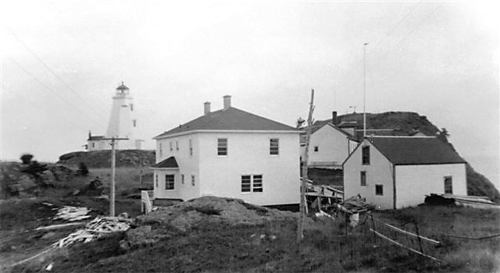
Swallowtail with outbuildings in 1958
Photograph courtesy Canadian Coast Guard
Swallowtail Lighthouse was in first-rate order when the Saxby Gale struck on October 4, 1869. The hurricane, accompanied by an unusually high tide, created a two-metre surge that caused significant damage in the Bay of Fundy. The keeper’s dwelling was so shaken by the storm that two chains were strung over the roof and secured to the rock on each side to keep it in position. The foundation of the lighthouse was significantly damaged, necessitating the construction of a substantial stone wall, resting upon the underlying solid rock, beneath the tower. Keeper Jonathan Kent retired in 1873 and was replaced by his son, John W. Kent, who initially earned an annual salary of $400.
Keeper Kent regularly received praise in the annual reports of the Department of Marine. The following example is from 1877: “Everything at this Station is in first class condition, and Mr. Kent takes great pride in keeping this Station, and its appurtenances in good order. He is a man of good taste, and this Station is visited by great numbers of strangers and excursionists who come to the Island during the summer season. Mr. Kent had given the lighthouse a coat of paint, which had lightened it up and greatly improved its appearance. Altogether, this Station may be considered the model station of the Department.”

Tragedy struck Swallowtail Lighthouse in August of 1936 when Elodie Foster was tending the light while her husband was away at Southwest Head Lighthouse. Elodie accidentally overfilled the light’s alcohol burner, and when she attempted to ignite the fuel, her clothes caught on fire. She managed to make it down the tower’s stairs and outside the lighthouse where she soon received help from her son Leonard and two daughters. Leonard raced up the tower and managed to extinguish the flames in the lantern room before the fire spread to the tower. Sadly, Elodie passed away the next day from her burns.
After filming the horror film Hemoglobin at the lighthouse in 1996, the movie producers paid to have the keeper's dwelling restored. Soon thereafter, the dwelling opened as the Swallowtail Inn, a bed and breakfast run by islanders Catherine Neves and her sister Crystal Cook. After operating for nearly a decade, the inn was shuttered in 2004, and the dwelling now sits vacant.
In March of 2008, the village council announced that the keeper's dwelling would be sold as upkeep was proving to be too expensive. Repairs had cost the community $80,000 in recent years. A well-publicized meeting was held on April 4th to come up with ideas to save the dwelling and resulted in the creation of the Swallowtail Keepers Society whose mission is to rejuvenate Swallowtail Lighthouse and make it a symbol of civic pride for the island. The village council, a bit surprised by the islanders' feelings on the matter, rescinded the motion to sell the keeper's dwelling during their April 7th meeting.
During 2013, the society received over $200,000 from various sources, including the provincial and federal government, to improve the footbridge, construct a boardwalk, produce marketing materials, and cover administration costs. (info: Lighthousefriends.com)

Thursday, March 31, 2016

Letete Lighthouse at Green Point

Letete-Lighthouse-NB_Simone-Ritter-Art_2016_watercolour_21x29in
Letete Lighthouse
orig. watercolour, 21x29in approx.
see it in person at Sunbury Shores Arts from May 6-20, 2016

Now today's lighthouse is home territory for me and I have painted it quite a few times over the years. The Letete Passage has strong currents due to the high tides in our area and the ferry service to Deer Island runs through every half hour.
There is a sweet little museum in the main building which is staffed by friendly locals that share much of the local history and folklore. You can also make this your special 'home away from home' with their vacation rental on site.
Here is more info about the Letete Lighthouse and a couple of fun stories from the Lighthouse Friends' website:
Letete is derived from the French “la tete,” which means “the head,” and likely refers to the headlands that bracket the passage.
In 1878, Parliament appropriated $1,500 for the erection of a steam-powered fog alarm at Letete Passage in Charlotte County, and the following year, D. W. Clark constructed the fog alarm building and a reservoir to supply the needed water at a cost of $2,774. A fog trumpet of a new and improved design was procured from the Neptune Fog Horn Company of Quebec for $1,750 and placed in operation in 1879. Every thirty seconds during thick weather, fogs, and snowstorms, the trumpet would sound seven-second blasts that could be heard an estimated six miles with the wind and just two or three miles against the wind.
The biggest change to the station occurred in 1903, when a lighthouse was placed on Green’s Point, then also known on navigational charts as Mascabin Point. C. L McKeen of St. Andrews built the wooden octagonal tower at a contract price of $800. The lighthouse was constructed at St. Andrews in eight sections, which were then transported to the point by scow and assembled at a spot just northwest of the fog alarm building. Topped by a red, octagonal, iron lantern, the tower measures forty-three feet from its base to the top of its ventilator and originally exhibited a fixed-white light from a seventh-order lens.
In the fall of 1920, a new fog alarm building was constructed on the point to house a Class “B” diaphone, powered by oil engines. The installation was completed the following year at a cost of $7.338. Keeper Dines had little faith in the newfangled gas motors and might have given up as keeper if his son Prescott hadn’t pitched in to keep them operating.
Prescott Dines took over as keeper of Green’s Point Lighthouse in 1936 when his father Sidney retired. Though electricity arrived at nearby Letete in 1937, Prescott recalls that electricity didn’t reach the station until 1952 because a neighbor wanted to charge the power company $10 per pole to cross his land.
Prescott remembers one winter gale that blew his mother right out of a one-horse sleigh, depositing her on rocks six feet below. Thanks to a large buffalo robe she was wrapped in, she suffered no harm. “One of my mother's guests chose a very windy day to visit us at the Lighthouse and consequently, the Privy house,” Prescott recalls. “No sooner had the gentle lady finished her business and exited from the Privy - when an extra big puff of wind blew the little building over the bank and onto the rocks below.”
In 1962, a year before his retirement, Prescott, who weighed about 130 lbs., experienced the full force of the wind firsthand. “The wind was of gale proportions and it took complete and absolute charge of me. The next thing I knew I found myself down on all fours among the rocks, alone and much bruised. I made up my mind, then and there, that as soon as possible I would retire, while I still had two feet and legs on which to go.”
In the late 1980s, Green’s Point became a monitoring station for several other lighthouses in the area. While most of the nearby stations were de-staffed, four full-time keepers were needed at Green’s Point to cover all the lights.
After being fully automated since 1996, Green’s Point Light was officially decommissioned on September 8, 1999, though the fog alarm remains in use. Ownership of the lighthouse and station was transferred to the Green’s Point Light Association in July 2008. A Coast Guard monitoring station on the property has served since 2002 as a vacation rental to raise money to maintain the property.

Tuesday, March 29, 2016

Range Tower at Wood Island Light

Wood-Island-Light-PEI_Simone-Ritter-Art_watercolour_2016_5x7in
Range Tower- Wood Island Light
orig. watercolour, 5x7in approx.
see it in person at Sunbury Shores Art, May 6-20
This little painting of a little lighthouse is one of the range towers near the Wood Island Lighthouse that I painted a few days ago (you can see it by clicking here).
As I am learning about lighthouses, as I paint them, Wikipedia is an informative companion for me. Here is what it states:
Leading lights (also known as range lights in the US) are a pair of light beacons, used in navigation to indicate a safe passage for vessels entering a shallow or dangerous channel; and may also be used for position fixing. At night, the lights are a form of leading line that can be used for safe navigation. The beacons consist of two lights that are separated in distance and elevation, so that when they are aligned, with one above the other, they provide a bearing. Range lights are often illuminated day and night.
In some cases the two beacons are unlighted, in which case they are known as a range in the United States or a transit in the UK. The beacons may be artificial or natural.

Operation of Range Lights:

Two lights are positioned near one another. One, called the front light, is lower than the one behind, which is called the rear light. At night when viewed from a ship, the two lights only become aligned vertically when a vessel is positioned on the correct bearing. If the vessel is on an incorrect course, the lights will not align.
During the day, the range tower lights may not easily be seen and therefore leading lights are often fitted with secondary visual aids, e.g. large red flags with wide black lines running down them. When both red flags and black lines line up, the navigator knows that the vessel is on the correct bearing. The structures are usually painted to make them more prominent.
Some major rivers, such as the Elbe River in Germany, have a series of leading lines. When it is necessary to make a turn, the navigator lines up the next pair of leading lights. This provides guidance from Hamburg to the sea, using successive pairs of leading lights.
Leading lights were used in England as early as 1763 to mark the Port of Liverpool.[3] The first set of range lights in the United States were privately established by subscription at Newburyport Harbor in Massachusetts in 1788.[4]
Leading lights are sometimes designed to be movable, allowing their position to be shifted in the event of a change in the safe channel; these include one at Hilton Head, South Carolina, the original Chatham Light, and the Nantucket Beacon, predecessor to the Nantucket Harbor Range.

Simone-Ritter-Art_Wood-Islands-PEI
One of the little Wood Islands Range Tower Lights

Friday, March 25, 2016

Wood Island Lighthouse - PEI


Wood Island Lighthouse PEI_Simone-Ritter-Art_2016_watercolour_21x29in

Wood Island Lighthouse- PEI

orig. watercolour 21x29in approx.
on display at my upcoming show May 6-20, 2016
A couple of years ago we went to visit Prince Edward Island. We had a great time and the kids enjoyed the full time attention from us parents without the distraction of phone calls or other business. It really was a good time and they still talk about those three days. We vistited end of October and most of the tourists were gone, so we discovered a quiet PEI.
Simone-Ritter-Art_2014_PEI_kids-flying-a-kite
Kids and Dad flying a kite in PEI while Mama                   is painting the lighthouse

Here is Wood Island Lighthouse, which was one of the very last open attractions and I remember the woman on the entrance was so welcoming and friendly. Friendly volunteers and staff make for a memorable visit and with PEI I can attest to this. We had brought kites and the kids and Markus flew them while I perched down on my little painting chair, doing a small plein air painting of this light house.
Simone-Ritter-Art_Wood-Island-Lighthouse_2014-watercolor-plein-air_5x7in
Wood Islands plein air sketch, 5x7in approx.                                    NFS

If you come to the East Coast, PEI is for most people a must. Its red sand beaches, warm waters and water parks, along with Anne of Green Gables shows draw crowds every summer. Lots of festivals and special events with music and food are scheduled every year.
The rolling hills landscape is quite different than New Brunswick and Nova Scotia and make for a unique flair. Go, check it out if you haven't had a chance to do so yet- or if you have, please share your story below, I'd love to hear your insider tip PEI!
Easter is coming, the holy Triduum days are here, I'm wishing you a blessed Easter time! Thanks for stopping by!                                                                                                       Simone